Designing materials from desired behavior
Data-efficient neural operators for the characterization and inverse design of stochastic metamaterials.
Research overview
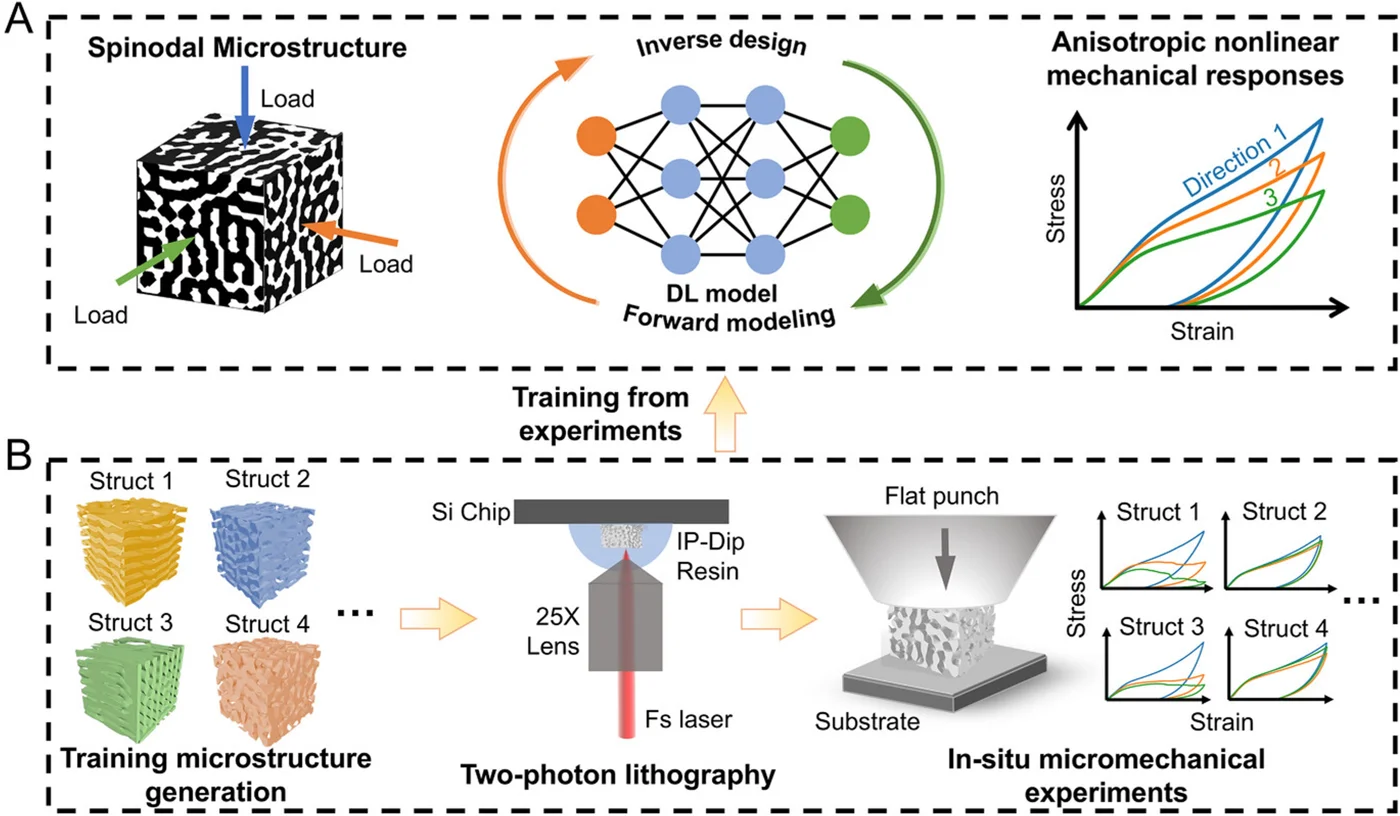
In this collaborative project, we developed a scientific machine learning framework to enable the inverse design of micro-architected metamaterials from sparse, high-fidelity experimental data. Traditional design methods for such materials often rely on dense simulations or costly lab experiments, particularly challenging for nonlinear and stochastic microstructures. Our approach leverages deep neural operators—including DeepONet and its variants—to directly learn the complex mappings between microstructural features and their mechanical responses. I contributed to the implementation and evaluation of the neural operator models and supported the comparative analysis between standard neural networks and operator-based architectures. Our results on spinodal microstructures fabricated via two-photon lithography demonstrated predictive accuracy within 5–10%, highlighting the method’s viability under data-constrained conditions. This work illustrates the power of integrating advanced ML with nanoscale experimentation to accelerate the design of next-generation mechanical metamaterials.
Good science starts
with a conversation.
Interested in research collaboration or joining SPARKS Lab? I welcome conversations across computer science, mathematics, physics, and engineering.
Department of Computer Science · Texas State University
310D Comal · San Marcos, Texas 78666