Resolving the missing scales of turbulence
Combining neural operators and diffusion models to recover high-frequency flow structures.
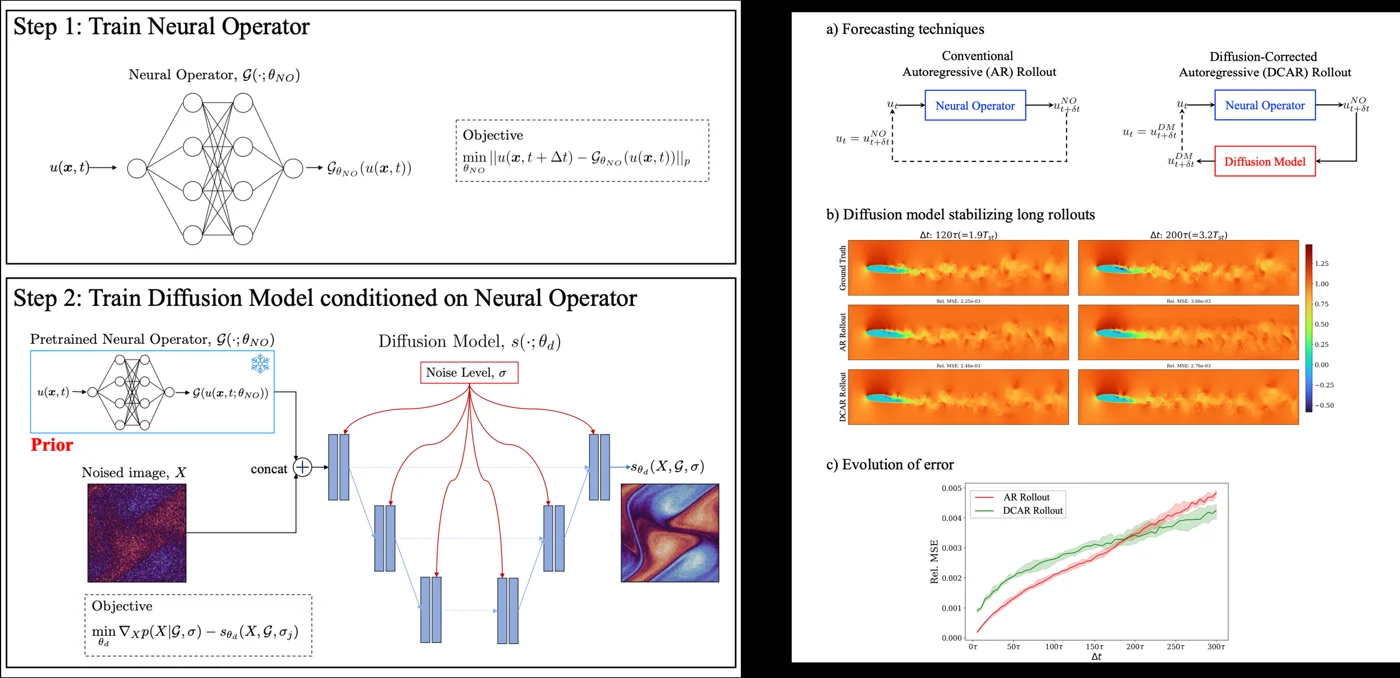
Research overview
In this collaborative project, we addressed a key limitation of neural operators in modeling turbulent flow: their inability to capture fine-scale, high-frequency structures. While neural operators such as Fourier Neural Operators (FNO) and DeepONets offer scalable and efficient surrogate modeling, their outputs tend to be overly smooth, failing to reproduce the rich spectral content of turbulence. To overcome this, we developed a hybrid framework where generative diffusion models are conditioned on neural operator predictions. This enables the diffusion model to restore high-frequency components lost during surrogate approximation. I contributed to the development of the hybrid architecture and led the validation across diverse datasets, including high Reynolds number jet flow simulations and experimental Schlieren velocimetry. Our method achieves markedly improved energy spectrum alignment and enables temporally stable autoregressive rollouts. Spectral analysis via Proper Orthogonal Decomposition (POD) further confirms enhanced fidelity in both space and time. This framework offers a generalizable approach for physics-informed generative enhancement, applicable to scientific systems requiring microstructural resolution.
Good science starts
with a conversation.
Interested in research collaboration or joining SPARKS Lab? I welcome conversations across computer science, mathematics, physics, and engineering.
Department of Computer Science · Texas State University
310D Comal · San Marcos, Texas 78666